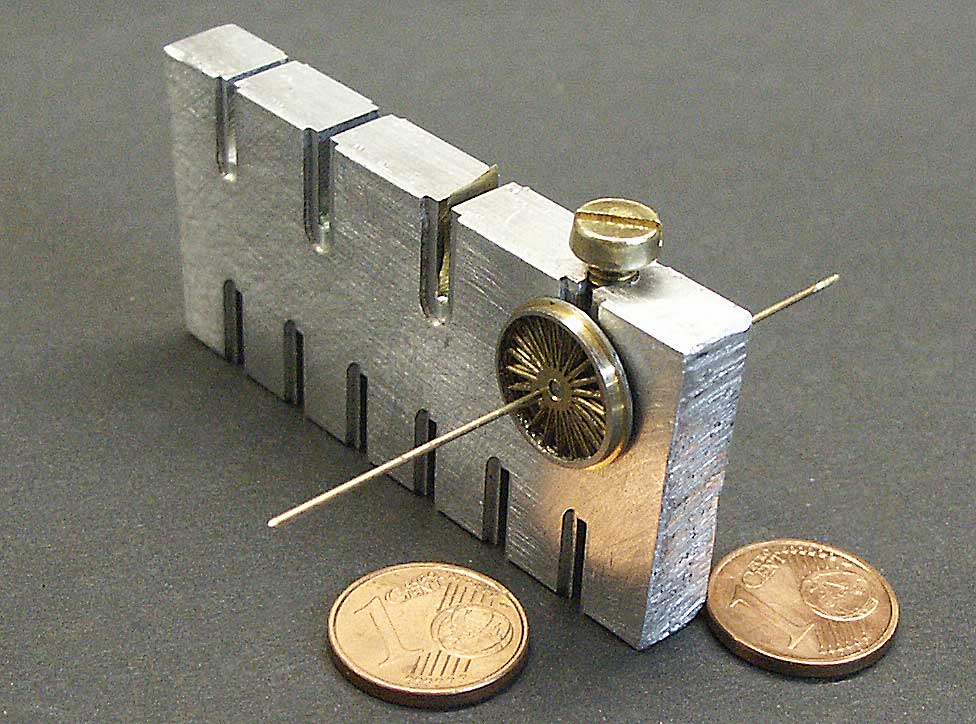
Una traduzione fatta veloce. Se si va google ricerca sotto "Quartering", trovi migliaia di descrizioni.
Quartering – the esay way
It appears from the occasional letter that I receive that a few people are still encountering problems in quartering the type of driving wheels which are a push fit on their axles. It is not really as difficult as it appears – just a matter of approaching the task in a logical manner. Let’s take a simple six-coupled chassis.
First, fit the rear pair of driving wheels in the frames and position the left hand wheel with crank pin at the top. Now, holding the left hand wheel in this position adjust the right hand wheel so that its crank pin is pointing towards the front of the locomotive.
Precise quartering (90°) at this stage is not essential.
Now fit the centre pair of wheels in much the same the quartering of the rear axle by eye. Fit the coupling rods to these two axles and test. At this stage you’ll probably find that everything is all right.
Lastly, fit the front pair of wheels and quarter by eye as before. Refit the coupling rods to all three axles and test run. If any binding occurs adjust the front axle only, do no touch the other two. That’s all there is to it!
Quartatura - modo semplice
Dalle lettere occasionali che ricevo risulta che alcune persone incontrano ancora problemi di quartatura delle ruote motrici, che sono “tipo” a pressione sul loro asse. In realtà non è così difficile come sembra - solo una questione di avvicinarsi il compito in modo logico. Prendiamo un semplice sei accoppiato telaio.
Prima, montare la coppia di ruote motrici posteriori nel telaio e posizionare la ruota sinistra con perno di manovella in alto (verticale). Ora, tenendo la ruota sinistra in questa posizione, regolare la ruota destra in modo che il perno di manovella sia rivolta verso la parte anteriore della locomotiva (orizzontale).
Quartatura precisa (90 °), in questa fase non è essenziale.
Ora montare la coppia di ruote centrali in stesso modo come le prime. Montare le aste di accoppiamento a questi due assi e provare. In caso di lavoro irregolare girare una ruota qualche decimo avanti o indietro, tenendo fissa altra. A questo punto probabilmente scoprirete che tutto è a posto.
Infine, montare la coppia di ruote anteriori sempre come le prime due. Rimontare le aste di accoppiamento a tutti i tre assi e fare del test. Se qualsiasi asta lavora non bene ritoccare le ruote dell l'asse anteriore, non toccare le altre due. Questo è tutto quello che c'è da fare!
Velimir

 Login
Login Iscriviti
 Home
Home FAQ
FAQ Cerca
Cerca